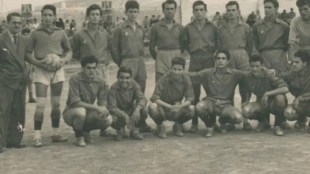




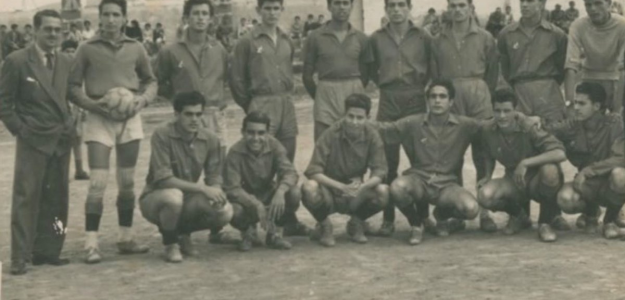
Lanzarote Events before the 100th anniversary of the Federation: over a century of football, from Campo Salinas to the 2026 World Cup A chronological reconstruction of football in Lanzarote: clubs, fields, leagues, youth development, women, referees, great cup nights, and the generations that made football a part of the island's memory Emilio Hernández Domínguez September 13, 2026 at 12:39 p.m. Updated: September 13, 2026 at 3:27 p.m. Share on Facebook Share on Bluesky Share on X Share on LinkedIn Share on Whatsapp Share on Whatsapp Share on Telegram Share by Email Photo provided to La Voz by Gerardo Hernández Listen to the article now... 1x 0:00 0:00 On September 13, 2026, the Interinsular Football Federation of Las Palmas celebrates one hundred years since its establishment. But Lanzarote did not start playing football in 1926. Its history is earlier, and precisely for that reason, the centenary offers an opportunity to tell it in full: from the first traces of the ball to the 2026 World Cup. The centenary of a Federation did not start in 1926 On Sunday, September 13, 2026, the Alfredo Kraus Auditorium in Las Palmas de Gran Canaria will host the central event of the centenary of the Interinsular Football Federation of Las Palmas. The date coincides exactly with the day, in 1926, when the Canarian Federation of Foot-ball Clubs was established, the institutional origin of the entity that today organizes and regulates a good part of the province's football. In this centenary, the institution has also been granted the title of "Royal" by His Majesty the King. The anniversary has a particular reading when seen from Lanzarote. The island is part of that federative history, but its relationship with the ball is much older than the Federation itself. There is documentary evidence of a match played in Arrecife in May 1903, of a first team organized in 1910, of clubs born in the 1920s, and of a progressive construction of fields, leagues, and structures that would eventually turn football into one of the great social phenomena of the island. Therefore, to narrate the centenary from Lanzarote necessitates a clarification: it is not one hundred years of football on the island. It is one hundred years of the federative institution. Lanzarote football has over a century of history. And in that journey fit Campo Salinas, the Olympic Stadium, La Vega, Avendaño Porrúa, the Sports City, the municipal fields throughout the island, UD Lanzarote, Orientación Marítima, Unión Sur Yaiza, Teguise, the island teams, women's football, referees, and, above all, entire generations of players and fans. 1903: the ball arrives before the Federation The first documented reference places May 21, 1903, as the date of the first imprint of football in Lanzarote. The setting was the Llanos del Reducto in Arrecife, and the protagonists were the crew members of the Swedish naval training ship "Saga," which had arrived in the port the previous day. It was not yet Lanzarotean football in the strict sense: they were foreign sailors playing on the island. But the episode matters because it demonstrates that the new sport had already made its mark in Arrecife as the 20th century was just beginning. Maritime routes, foreign presence, and commercial contacts with territories where football was fully established facilitated the game's awareness in Lanzarote. Seven years later, there would be a qualitative leap. In 1910, the brothers Antonio and Manuel Molina Orosa returned from England with sports equipment—clothing, two balls, and even a "bulb"—and were considered pioneers of football practice on the island. That same year, the first team officially considered constituted in Lanzarote was formed, composed of members of the Gymnastics and Recreation Club of the Democracia Society of Arrecife. Another story begins there: the football that stopped being a curiosity from outside to become an activity organized by the own Lanzaroteans. 1924-1925: Teguise, Arrecife, and Campo Salinas In 1924, the CD Guanapay was established, considered the first football team in Teguise. One year later, in 1925, the Club Deportivo Arrecife was born. On July 26 of that year, the Atlántico field was inaugurated, also known as Campo Salinas, in the La Vega area, on a plot located between the current streets of Triana, Portugal, Argentina, and Mexico. The inaugural match pitted CD Arrecife against CD Guanapay. It was not just another match; it was a founding scene. Two of the first organized nuclei of Lanzarotean football met on a field that would become a reference point in the island's sports memory. On September 22, 1925, another decisive moment arrived: CD Arrecife became a federative club. It was the first team in Lanzarote to achieve that status. That is, when the Canarian Federation of Foot-ball Clubs was established the following year, Lanzarote had already taken the first step towards federated football. The temporal difference is important. Football had been on the island long before; provincial federative organization came later. The centenary of 2026 should be read, therefore, as part of a longer history. 1930-1944: fields, clubs and the first insular League The thirties consolidated football as a stable practice. In 1930, the La Vega field was remodeled by placing its goalposts. In 1935, new teams emerged, including CD Lanzarote, Titerroy-Gatra, and CF Gimnástico. The football map was beginning to expand. International dimension also made an appearance. In October 1937, crew members of the German training ship "Schleswig-Holstein," anchored in Arrecife for several days, played a match against a local selection. It was a scene that would be repeated in different forms for decades: Lanzarote as a small island but open to the world through its port. The big leap came on March 1, 1942, with the inauguration of the Olympic Stadium of Lanzarote, in Arrecife. The project had a budget of 500,000 pesetas, a capacity for around 5,000 spectators, and a playing field of 105 by 70 meters. The size of the venue said much about the importance that football was beginning to acquire. In 1942, the CD Price from Tenerife also visited the island, one of the standout teams of its time in the regional sphere. In 1943, the first insular League championship was played, corresponding to the 1943-44 season. The champion was Club Osborne. One year later, on November 8, 1944, the Torrelavega Society of Culture, Recreation, and Sports was formally established. Its first president was Nicolás Martín Cabrera, and its board of directors included César Manrique. Football was not isolated from social life: it was integrated into cultural and recreational societies that functioned as true meeting centers for the population. The fifties: the island begins to export footballers In 1952, UD Máguez was founded in Haría, and in 1953, the football field of Teguise was inaugurated. The sport ceased to be essentially concentrated in the capital and found its own spaces in other municipalities. But the decade also left a signal that Lanzarotean talent could travel. On January 4, 1959, Miguel Eugenio Ascensión made his debut with Rayo Vallecano after having played at UD Las Palmas. It was a sign of a process that would repeat itself: footballers born or trained in Lanzarote who left the island to try to make their way in higher categories. Among these names stands out Antonio Betancort, born in Haría. Formed in Gran Canaria, he reached UD Las Palmas and later Real Madrid. With the Madrid club, he won a European Cup, six Leagues, and two Cups, in addition to two Zamora trophies, and was international and a World Cup player. Betancort's story demonstrates that Lanzarotean football cannot be measured solely by the clubs competing within the island: it also resides in the players who left it and reached the elite. Another name from that generation was José Hernández, known as "Lobito Negro," born in Arrecife in 1926. Atlético de Madrid included him in the 1949-50 season, and he wore the red-and-white shirt for nine seasons. Rafael Morera Hernández, born in Arrecife in 1903, played for Real Madrid between 1928 and 1931, participating in 66 official matches and winning three regional championships. Three different stories, three eras, the same evidence: Lanzarote had been producing footballers capable of competing outside the island for decades. 1968-1970: football enters a new dimension In 1968, the Avendaño Porrúa polideportivo of Arrecife was inaugurated. On that occasion, UD Las Palmas, then one of the great Spanish teams, faced a local selection. The result was 0-5. More important than the score was what the event represented: a modern venue, a major rival, and an audience seeing how the football of the island connected with the higher level. On March 7, 1969, a particularly significant date arrived: the first documented women's football match was played in Lanzarote, featuring teams from the Institute of Secondary Education in Arrecife. That seemingly modest match foreshadowed a story that would take decades to reach the top category. In 1970, Union Deportiva Lanzarote was created. The club would end up becoming the main competitive reference in the island's football and would feature in some of the most important pages of the conejera sports history. 1974: 31 teams on the same field Perhaps the best photograph of the growth of insular football is not a final or a promotion. It is a collective image: in March 1974, a demonstration of all football in Lanzarote brought together 31 teams at the Avendaño Porrúa for the trophy presentation. Thirty-one teams on an island that then had a much smaller population. The figure helps to understand that football was no longer the exclusive domain of a few clubs in Arrecife. It was an extended social and sports network spread throughout the insular geography. In August of that same year, the lighting of the Avendaño Porrúa was inaugurated. Football gained hours, audience, and possibilities. It also gained a new dimension: training and playing with artificial light meant approaching the conditions of the great sports arenas. In February 1977, a Lanzarote selection faced the university selection of Argentina and lost 1-2. In October 1978, UD Lanzarote player Román de León traveled to England to try out with Nottingham Forest. And in July 1979, Gerardo Hernández became the first Lanzarotean referee to ascend to the Third Division. The island was already producing players, selections, and referees capable of competing outside its territory. 1981: an island already playing with the outside world In December 1981, UD Lanzarote played an international friendly against Koldikg I.F. from Denmark. It ended 1-1. The data might seem trivial compared to the subsequent great nights, but it is part of an evolution: Lanzarotean football had ceased to look exclusively towards the Canary Islands and started using its tourist and international ties as well. Lanzarote's football history is full of these small connections. Foreign teams on vacation, national teams visiting the island, friendlies, tournaments, and camps. In a land whose economy and society were rapidly internationalizing, football also served as a showcase. The nineties: the youth shows there is a future In 1991, the Altavista field in Arrecife was inaugurated. In 1992, a photographic exhibition on the history of football at the Democracia Society showed that the sport already had a sufficiently extensive memory to become the subject of recovery and conservation. On April 9, 1994, one of the youth successes arrived: the Lanzarotean youth selection won the IX International Tournament Ciudad de Zaragoza. It was not a professional championship or a major category, but a demonstration that grassroots work could yield results outside the Canary Islands. Refereeing also carved its own path. In 1995, the first Torch of Concordance was celebrated, organized by the provincial and local refereeing group. The history of football is not only written by those who score goals. It is also written by those in the center of the field with a whistle, those who train young players, and those who maintain the rules when pressure rises. In 1999, a change of scale arrived: UD Lanzarote ascended to the Segunda B for the first time. Thus, Lanzarote entered the bronze category of Spanish football. UD Lanzarote and the decade that changed the perception of the island UD Lanzarote quickly established itself in Segunda B. Before receiving Real Madrid, it starred in another historic night: on October 10, 2001, it knocked out CD Tenerife, then in La Liga, with a 5-1 victory. The match was officiated by Eduardo Iturralde González, with Rafael Guerrero as the assistant. The triumph paved the way for the unforgettable Madrid visit weeks later. The club also faced Atletico Madrid in the Copa del Rey, in a highly competitive round. In the 2003-04 season, UD Lanzarote was the champion of Group IV in Segunda B and played in the promotion phase to the Segunda Division. Although it did not secure the promotion, it had reached the highest competitive level of a Lanzarotean club. The Copa del Rey still held unforgettable nights. In the 2004-05 season, UD Lanzarote defeated Mallorca 2-1 and later overcame Athletic Club 2-1 in Arrecife. The team advanced to the round of 16, where they fell to Athletic 0-6 at San Mamés. Nonetheless, the campaign was remembered as one of the greatest Copa del Rey feats in the history of Lanzarotean football. The official history of UD Lanzarote documented those episodes alongside the Real Madrid visit and the Segunda B championship of 2003-04. The Cup had proven that an island team could make noise in national football. 2006: two Lanzarote clubs in Segunda B at the same time If there was a moment that summarized the dimension achieved by Lanzarotean football, it was the summer of 2006. The Orientación Marítima faced Granadilla in the decisive promotion playoff. On June 25, before a crowd of about 3,000 fans at the Ciudad Deportiva, they won 3-1. Rosmen's goal came in the last minute of extra time, as the match seemed headed for penalties. The promotion had a historical consequence: for the first time, Lanzarote would have two teams simultaneously in Segunda B, the bronze category. UD Lanzarote had been established there for years; Marítima had just opened a door that seemed reserved for big clubs. The debut of the Orientación Marítima was particularly symbolic. On August 26, 2006, they faced UD Lanzarote. David Martín scored the only goal, and Marítima won 1-0. Two clubs from the same island, face to face, in the national category. The dream lasted a season. Marítima competed in Segunda B during 2006-07 but ended up being relegated. However, that season remained one of the most unique milestones of Lanzarotean football. And behind that success was also a generation of players and coaches. Juan Antonio Machín had already been involved in previous promotions, and the club added experienced players, including Maciot Dévora, known as "El Negro," who came from UD Lanzarote. The sporting rivalry coexisted with a shared island heritage. 2010-2011: UD Lanzarote returns to the bronze category UD Lanzarote returned to Segunda B in the 2010-11 season after becoming Tercera Division champions. The promotion returned the club to a category that was already part of its competitive identity. By that point, Lanzarotean football had accumulated a long list of teams and fields. But it had also built its own sporting culture: players starting in youth categories, coaches accompanying them, referees moving up and down the national pyramid, directors supporting clubs with limited resources, and fans continuing to travel to support their teams. Refereeing: from Gerardo Hernández to the World The history of refereeing deserves its own chapter. In 1979, Gerardo Hernández was the first Lanzarotean to ascend to Tercera Division. Decades later, another name took the island much further: Alejandro Hernández Hernández, a Lanzarotean referee who reached La Liga and became a benchmark in Spanish refereeing. In 2026, there was an extraordinary international leap in history: FIFA confirmed his appointment as the main referee for the World Cup in the United States, Mexico, and Canada. He was included among the 52 main referees selected for the tournament. His participation in a World Cup turned an individual career into a collective symbol. In July 2026, the FIFLP honored Alejandro Hernández Hernández after his participation in the tournament and, along with José Enrique Naranjo, awarded him the gold and brilliant insignia of the institution. Both were the only Spanish field referees present at the World Cup. However, 2026 added another name to the story. Ágata López García became the first female referee from Lanzarote to ascend to the women's La Liga, Liga F. Her journey had started at just eleven in the initiation course, and her first federated match arrived at twelve. After progressing through the women's Segunda Division and competing in male categories, she reached the top division in 2026. The simultaneity was extraordinary: in the same year as the federative centenary, Lanzarote had a presence in the top male and female refereeing categories nationally and, furthermore, one of its referees reached the World Cup. Women: from that 1969 match to the elite Lanzarotean women's football has a history that
This news is an automatic translation. You can read the original news, Nuevo enfoque: Una reconstrucción cronológica del fútbol lanzaroteño: clubes, campos,


-
 12 Sep 2026 | 15:00Spain criticizes Argentina for incidents in the 2026 World Cup final
 -
 14 Sep 2026 | 18:00Marcelo Gallardo, the challenge of leading Ecuador towards the 2030 World Cup
 -
 13 Sep 2026 | 00:00New call-up for the Argentina National Team: renewal and surprises
 -
 14 Sep 2026 | 21:00Akron Stadium: Tribute to the 2026 World Cup
 -
 13 Sep 2026 | 12:00John Lucumí values Colombia's performance in the 2026 World Cup
 -
 14 Sep 2026 | 12:00Miguel Méndez, the leader behind the success in the 2026 World Cup